The SOXL long I refused to chase at 112 — filled 105.5, out 124.9
View original analysis report →
The receipt
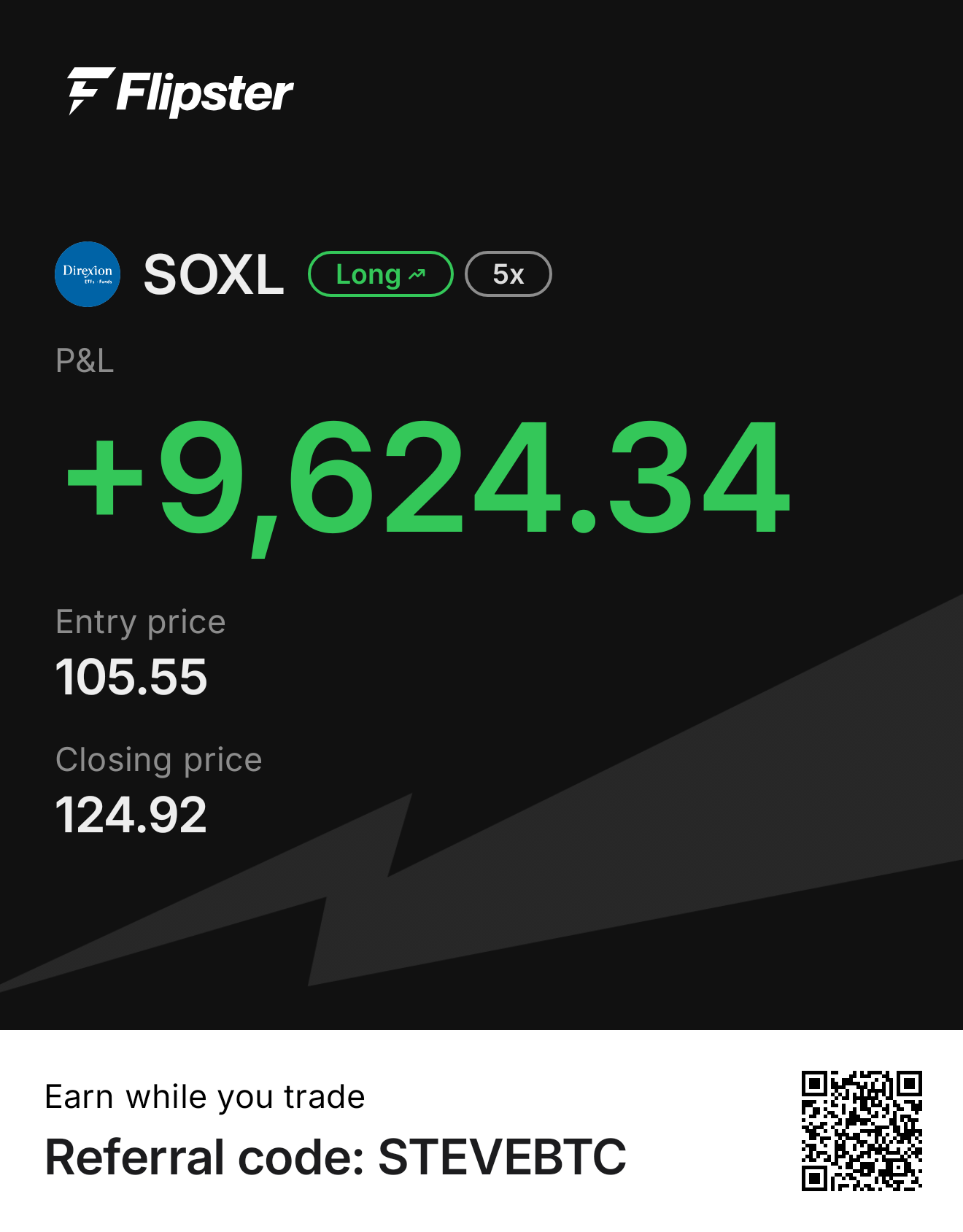
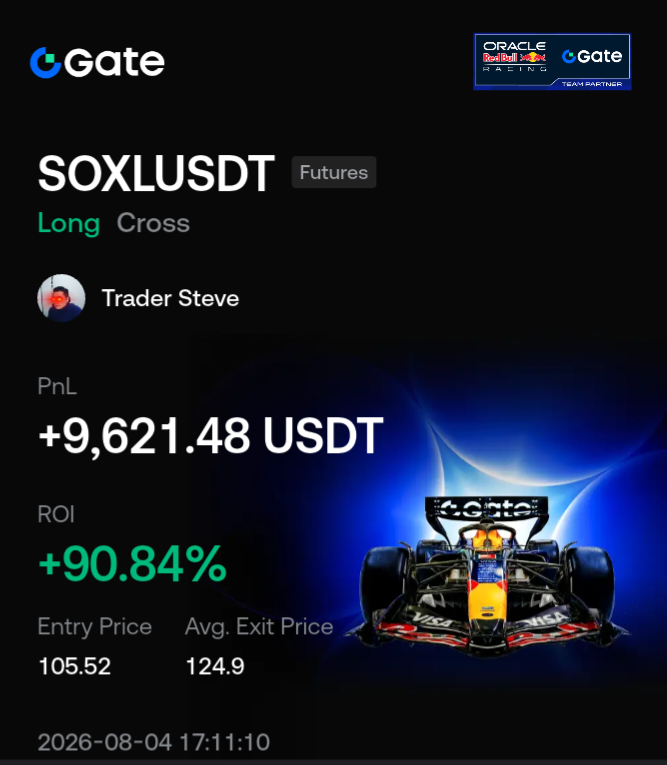
$SOXL long on the 4h, called August 4 with a resting limit at 103–107, a stop at 98, and a first target at 121. Price was 112.87 when the call went out and I did not buy it there. The limit filled at 105.5 the following session and the position closed at 124.9. On both Flipster and Gate that reads plus 90.84 percent at 5x, roughly plus 9,620 USDT — the same single position recorded on two venues, not two trades. On the call's own terms it was an 18.4 percent move in the underlying with the first target tagged and then some.
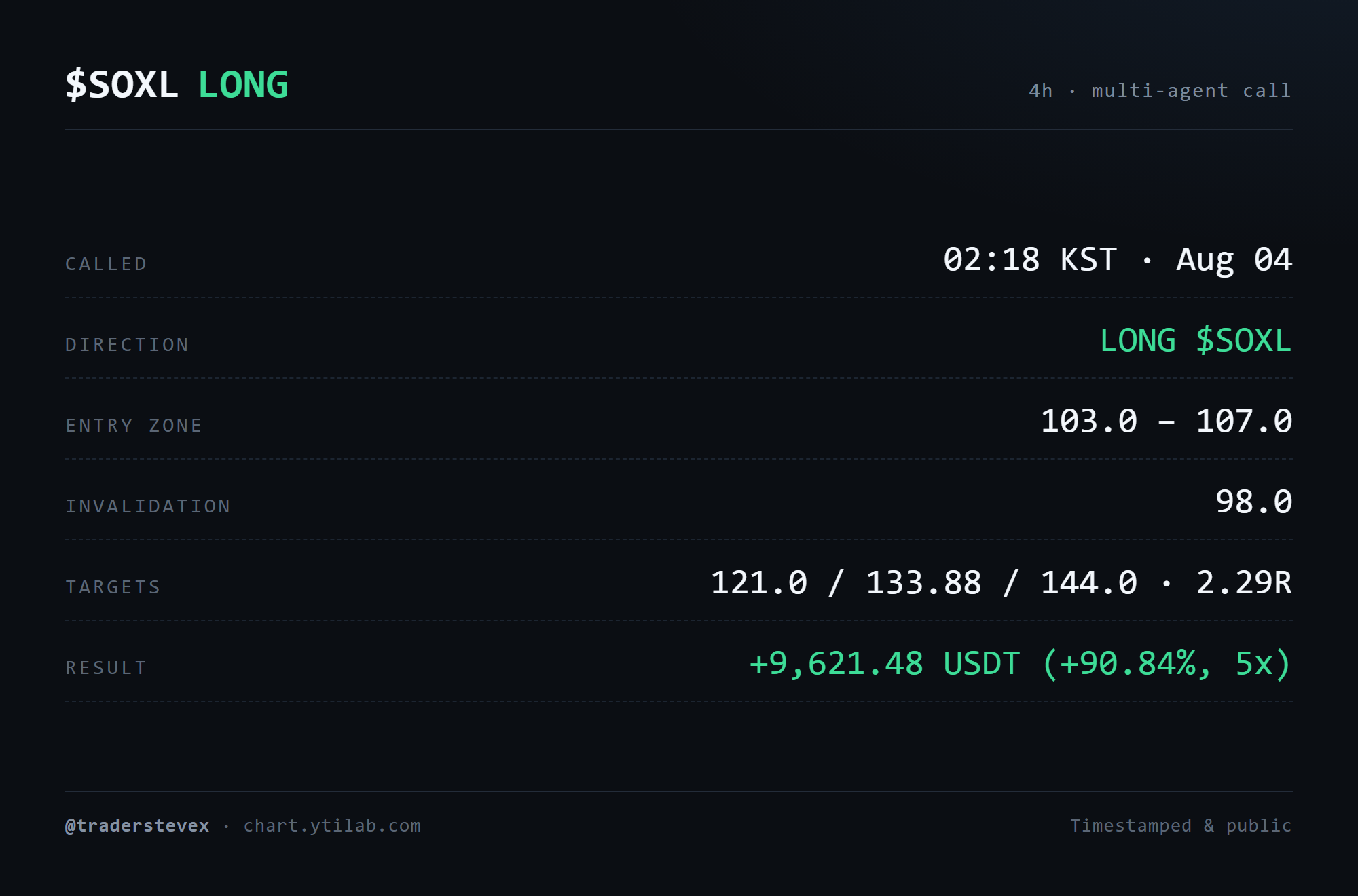
The setup
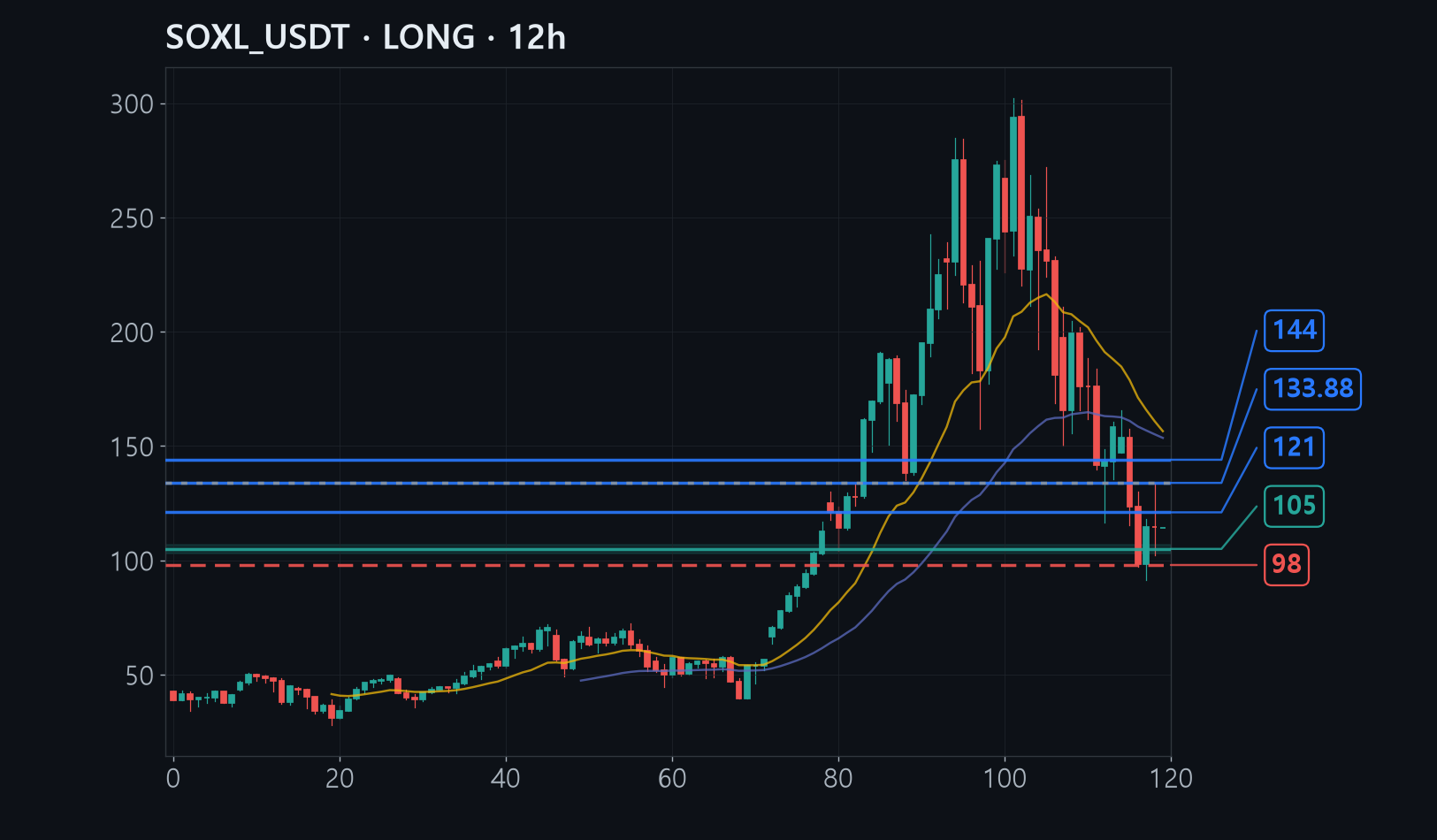
The location was anything but clean. SOXL had fallen from 302 to 91.5 in three weeks, a 70 percent collapse. Every EMA on the 4h and 12h sat above price, and not one of the descending highs — 272, 204.55, 165.75, 133.88 — had been reclaimed. In the six-model vote the macro model wanted to short, and its evidence was the dominant trend itself. Confidence was capped at 55 for exactly that reason. This was never framed as a bottom. It was a rebound with the risk written down before the entry.
The signals
Three signals carried it. First, a regular bullish divergence on the 4h — price prints a lower low while momentum prints a higher low. From 116.47 to 91.5 price made the lower low, but RSI lifted from 37.2 to 38.0 and the MACD histogram rose from -3.37 to -2.34, and the 1h and 15m confirmed the same shape at the 102.09 low. It was the most objective piece on the board and carried the highest sub-confidence of the six. Second, the volume told a bottoming story: the 91.5 low on July 29 came on 149.95 million shares, the largest bar of the whole decline, with a long lower wick — a selling climax — while the retest to 102.09 on August 3 came on 60 million, roughly 60 percent less, and the low itself lifted from 91.5 to 102.09. Third, the 103–107 entry was a stack, not a guess: the bullish FVG and order block from the August 3 impulse at 102–106, the optimal-trade-entry band at 100–108, and the 61.8 percent retracement at 107.7 all overlapped there, while 112.87 sat above range equilibrium on the premium side. So the order rested in discount and waited. The disagreement is worth keeping: macro voted short and was not wrong about the trend, yet its own third-ranked scenario was a counter-trend long at 105–109. The models argued about direction and agreed about the zone.
What would have killed it
The ways it could have died were spelled out first, not in hindsight. A 4h close below 98 breaks the 102.09 higher low, the FVG base, and the retracement floor in one move — that was the line, defined before entry. Gap risk was real: this same instrument closed 114.61 on July 31 and opened 106.15 on August 3. If price had run straight through 121.9 without retracing, the limit never fills and the round ends flat — an unfilled order is not a loss. The macro calendar was loaded, too: the August 7 jobs report and the August 12–13 CPI and PPI could have repriced September hike odds higher, in which case the long was to be withdrawn before it even filled. And because a 3x fund bleeds to volatility decay, a two-to-five-day time stop sat on top of everything. None of that fired. It could have.
The lesson
The lesson is the plain one. At the middle of a range there is no trade — the reward-to-risk only exists at the edge. Refusing to buy 112.87 and letting the limit sit at 105.5 was the entire distance between a coin flip and a plus 18 percent move in the underlying. And when a five-to-one vote has its lone dissent pointing at the primary trend, you are trading a rebound, not a reversal: you bank the first target, and you write down 98 before you click buy.